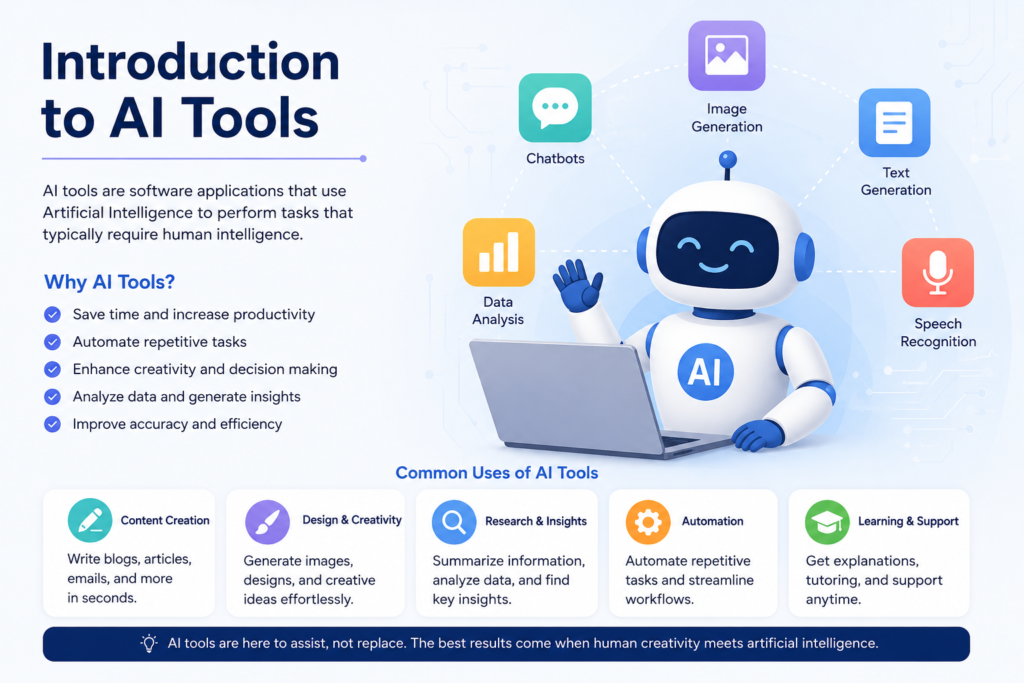
Artificial Intelligence (AI) tools are software applications that use AI technologies such as machine learning, natural language processing, computer vision, and automation to perform tasks that typically require human intelligence.
What Are AI Tools?
AI tools can:
- Analyze large amounts of data
- Generate text, images, audio, and video
- Automate repetitive tasks
- Assist with decision-making
- Improve productivity and creativity
Examples include chatbots, image generators, recommendation systems, translation software, and predictive analytics platforms.
Common Categories of AI Tools
1. Text Generation and Writing
These tools help create and edit written content.
Examples:
Uses:
- Content writing
- Email drafting
- Summarization
- Translation
2. Image Generation and Design
These tools create or edit images based on text prompts.
Examples:
Uses:
- Graphic design
- Marketing materials
- Digital art
- Social media content
3. Audio and Speech Tools
These tools generate, transcribe, or analyze audio.
Examples:
Uses:
- Voiceovers
- Meeting transcription
- Accessibility support
4. Video Creation Tools
AI can help generate and edit videos quickly.
Examples:
Uses:
- Training videos
- Marketing content
- Educational materials
5. Data Analysis and Business Intelligence
These tools help organizations gain insights from data.
Examples:
Uses:
- Trend analysis
- Forecasting
- Business reporting
Benefits of AI Tools
✅ Increased productivity
✅ Faster decision-making
✅ Reduced manual effort
✅ Improved accuracy
✅ Enhanced creativity
Challenges and Limitations
⚠️ Data privacy concerns
⚠️ Potential bias in AI models
⚠️ Dependence on data quality
⚠️ Possible inaccuracies (“hallucinations”)
⚠️ Ethical and legal considerations
Applications Across Industries
- Education: Personalized learning and tutoring
- Healthcare: Diagnosis support and medical imaging
- Finance: Fraud detection and risk assessment
- Marketing: Customer insights and content creation
- Manufacturing: Predictive maintenance and automation
Conclusion
AI tools are transforming how individuals and organizations work by automating tasks, generating content, and providing data-driven insights. Understanding the different types of AI tools and their applications is essential for leveraging AI effectively in today’s digital world.